
Nestled within the Liri river valley, Sora was a crossroads for the commercial exchanges of its neighbouring cities, witness of the struggles between pagans and Christians, and the victim of banditry and a terrible earthquake that razed it to the ground. The symbol of its historical and strategic importance is the Avezzano-Roccasecca railway, which not only provided for a needed railway line connecting Lazio region and Abruzzo region, but turned it into a thriving and beautiful city.
The visit of the city starts when crossing the bridge Napoli, which leads to the old town centre full of alleys and old workshops embedded in the urban fabric. In this area, you can find the first great architectural structure: the Abbey of San Domenico. Founded on the ruins of the villa of Cicero and at the confluence of the Fibreno river with the Liri river, the abbey was built as a proof of the conversion and devotion of the governor of Sora and Arpino, thus becoming a symbol of the transition from pagan to Christian rites. Going past the old town centre and walking towards the hill known as Colle San Casto, you can stop by the Museum of “Media Valle del Liri” (Middle Liri Valley), which is located in the 14th-century palace known as the former Convent of the Conventual Minors. The museum is organized according to chronological, thematic and topographical criteria with the aim of illustrating the history of the city and its territory. At a short distance, and initially conceived as a building outside the city walls, there is the Cathedral of Santa Maria Assunta, which was later extended with the construction of an Aragonese fortified tower and next to which the Bishop's Palace was built, considered one of the oldest in Italy. From the Cathedral you can walk to the building dedicated to the patron saint of the city, Santa Restituta, on whose facade the "Privilege of Charles II of Anjou” is carved in medieval Latin and on marble slabs, a document proving Sora to be established as a part of the kingdom of Naples and Sicily.
Slowly walking away from the city centre, outside the walls there is a place set as a destination for silent walks: the Castle San Casto, located at the entrance of the valley known as Val Roveto and 500 meters high above Sora. The castle is a monument of considerable cultural and military importance and was erected as a defence post with cyclopean polygonal walls. A “giant” that can still be visited today and that combines the beautiful landscape with its majestic architectural structure.
The heritage of the city of Sora, however, does not lie only in its magnificent buildings, the silent flowing of the Liri River and the network of alleys decorating it. Its culture, history and position have led to the development and careful study of its dialect, as well as the creation of a significant literary heritage, which is the symbol of the historical and identity value of the city and a gem of local tradition.
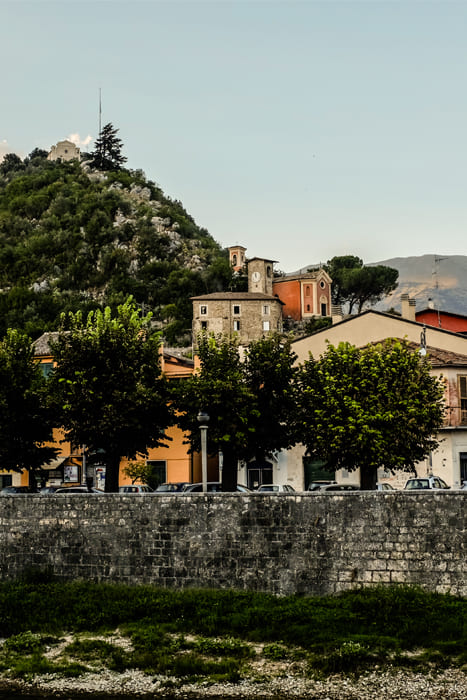
Nestled within the Liri river valley, Sora was a crossroads for the commercial exchanges of its neighbouring cities, witness of the struggles between pagans and Christians, and the victim of banditry and a terrible earthquake that razed it to the ground. The symbol of its historical and strategic importance is the Avezzano-Roccasecca railway, which not only provided for a needed railway line connecting Lazio region and Abruzzo region, but turned it into a thriving and beautiful city.
The visit of the city starts when crossing the bridge Napoli, which leads to the old town centre full of alleys and old workshops embedded in the urban fabric. In this area, you can find the first great architectural structure: the Abbey of San Domenico. Founded on the ruins of the villa of Cicero and at the confluence of the Fibreno river with the Liri river, the abbey was built as a proof of the conversion and devotion of the governor of Sora and Arpino, thus becoming a symbol of the transition from pagan to Christian rites.
Going past the old town centre and walking towards the hill known as Colle San Casto, you can stop by the Museum of “Media Valle del Liri” (Middle Liri Valley), which is located in the 14th-century palace known as the former Convent of the Conventual Minors. The museum is organized according to chronological, thematic and topographical criteria with the aim of illustrating the history of the city and its territory.
At a short distance, and initially conceived as a building outside the city walls, there is the Cathedral of Santa Maria Assunta, which was later extended with the construction of an Aragonese fortified tower and next to which the Bishop's Palace was built, considered one of the oldest in Italy.
From the Cathedral you can walk to the building dedicated to the patron saint of the city, Santa Restituta, on whose facade the "Privilege of Charles II of Anjou” is carved in medieval Latin and on marble slabs, a document proving Sora to be established as a part of the kingdom of Naples and Sicily.
Slowly walking away from the city centre, outside the walls there is a place set as a destination for silent walks: the Castle San Casto, located at the entrance of the valley known as Val Roveto and 500 meters high above Sora. The castle is a monument of considerable cultural and military importance and was erected as a defence post with cyclopean polygonal walls. A “giant” that can still be visited today and that combines the beautiful landscape with its majestic architectural structure.
The heritage of the city of Sora, however, does not lie only in its magnificent buildings, the silent flowing of the Liri River and the network of alleys decorating it. Its culture, history and position have led to the development and careful study of its dialect, as well as the creation of a significant literary heritage, which is the symbol of the historical and identity value of the city and a gem of local tradition.
"Living Villages" chain of the Ciociaria-Valle di Comino DMO:

Il programma del FestiVal di Comino sarà organizzato in sette grandi aree tematiche, per offrire un racconto completo e variegato della Valle, valorizzandone identità, storia e potenzialità.
Clicca sulle aree tematiche per scoprire gli eventi in programma.
Il calendario è in continuo aggiornamento con nuove attività: torna spesso per scoprire tutte le novità.

Via Umberto I, 1 - 03030 Pescosolido (FR)
Con il contributo della


DMO Ciociaria Valle di Comino 2024 C.F: 91033330605 | Tutti i diritti riservati. | by idealmente.net
| Cookie | Durata | Descrizione |
|---|---|---|
| cookielawinfo-checkbox-analytics | 11 months | This cookie is set by GDPR Cookie Consent plugin. The cookie is used to store the user consent for the cookies in the category "Analytics". |
| cookielawinfo-checkbox-functional | 11 months | The cookie is set by GDPR cookie consent to record the user consent for the cookies in the category "Functional". |
| cookielawinfo-checkbox-necessary | 11 months | This cookie is set by GDPR Cookie Consent plugin. The cookies is used to store the user consent for the cookies in the category "Necessary". |
| cookielawinfo-checkbox-others | 11 months | This cookie is set by GDPR Cookie Consent plugin. The cookie is used to store the user consent for the cookies in the category "Other. |
| cookielawinfo-checkbox-performance | 11 months | This cookie is set by GDPR Cookie Consent plugin. The cookie is used to store the user consent for the cookies in the category "Performance". |
| viewed_cookie_policy | 11 months | The cookie is set by the GDPR Cookie Consent plugin and is used to store whether or not user has consented to the use of cookies. It does not store any personal data. |

