
In the heart of the Comino Valley and in the beautiful Italian National Park of Lazio, Abruzzo and Molise you can visit the town of Alvito, a small rural gem on the slopes of Monte Morrone arranged on three levels as a typical fortress town. After the decline of the Benedictine Civitas Sancti Urbani (the city of Saint Urbano), the first settlement of Alvito was established (whose name comes from the Latin name of the mountain, mons Albetum): the first evidence can be traced back to 1096 and it can still be seen today in the small hamlet of Castello.
From here our walk starts, diving into the memories of Castello Cantelmo, which dates back to the end of the 11th century and sits juts on the top of the hill overlooking Alvito’s plain. The first fortress was built by the Counts of Marsi, of Lombard origins, but was rebuilt in the 14th century under the rule of the Cantelmo Family, who had taken over the government of Alvito from the noble family of Aquino at the end of the century and turned the Castle into a real military fortress. Today the Castle is owned by the town council and, despite several earthquakes and years of gradual decay, still shows all its medieval traits.
On the first floor, being the “noble floor”, there is the Sala del Trono (Throne Room) now being used as municipal Theatre, featuring several Art Nouveau-styled works, and the old gallery, now hosting the meetings of the town council, where you can admire the paintings by the art school of the Baroque master Luca Giordano. Inside the Palace it is possible to visit the museum of musical instruments from all over the world and the theatre library, whose books were donated by Enzo Samaritani, a writer, artist and musician born in Alvito, or sometimes enjoy a temporary exhibition on painting, photography and different kinds of art.
Going down Corso Mario Equicola you can reach Palazzo Ducale (Ducal Palace), also known as Palazzo Gallio. The Palace was built between the end of the 14th century and the beginning of the 17th century by the Gallio family, who were the lords of Alvito and owned most of the Comino Valley between 1595 and 1795 (being awarded the title of Dukes in 1606), and is today home to the town hall. Palazzo Ducale o Palazzo GallioThe Palace was built between the end of the 14th century and the beginning of the 17th century by the Gallio family, who were the lords of Alvito and owned most of the Comino Valley between 1595 and 1795 (being awarded the title of Dukes in 1606), and is today home to the town hall. Through the “portico” called Le Logge you can access the entrance hall where an inscription remembers the 21 people from Alvito who bought the palace to turn it into the town hall.
On the first floor, being the “noble floor”, there is the Sala del Trono (Throne Room) now being used as municipal Theatre, featuring several Art Nouveau-styled works, and the old gallery, now hosting the meetings of the town council, where you can admire the paintings by the art school of the Baroque master Luca Giordano. Inside the Palace it is possible to visit the museum of musical instruments from all over the world and the theatre library, whose books were donated by Enzo Samaritani, a writer, artist and musician born in Alvito, or sometimes enjoy a temporary exhibition on painting, photography and different kinds of art.
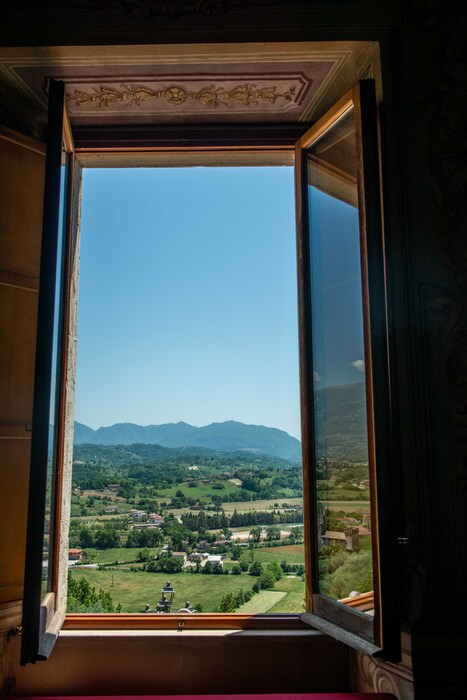
In the heart of the Comino Valley and in the beautiful Italian National Park of Lazio, Abruzzo and Molise you can visit the town of Alvito, a small rural gem on the slopes of Monte Morrone arranged on three levels as a typical fortress town. After the decline of the Benedictine Civitas Sancti Urbani (the city of Saint Urbano), the first settlement of Alvito was established (whose name comes from the Latin name of the mountain, mons Albetum): the first evidence can be traced back to 1096 and it can still be seen today in the small hamlet of Castello.
From here our walk starts, diving into the memories of Castello Cantelmo, which dates back to the end of the 11th century and sits juts on the top of the hill overlooking Alvito’s plain. The first fortress was built by the Counts of Marsi, of Lombard origins, but was rebuilt in the 14th century under the rule of the Cantelmo Family, who had taken over the government of Alvito from the noble family of Aquino at the end of the century and turned the Castle into a real military fortress. Today the Castle is owned by the town council and, despite several earthquakes and years of gradual decay, still shows all its medieval traits.
On the first floor, being the “noble floor”, there is the Sala del Trono (Throne Room) now being used as municipal Theatre, featuring several Art Nouveau-styled works, and the old gallery, now hosting the meetings of the town council, where you can admire the paintings by the art school of the Baroque master Luca Giordano. Inside the Palace it is possible to visit the museum of musical instruments from all over the world and the theatre library, whose books were donated by Enzo Samaritani, a writer, artist and musician born in Alvito, or sometimes enjoy a temporary exhibition on painting, photography and different kinds of art.
Going down Corso Mario Equicola you can reach Palazzo Ducale (Ducal Palace), also known as Palazzo Gallio. The Palace was built between the end of the 14th century and the beginning of the 17th century by the Gallio family, who were the lords of Alvito and owned most of the Comino Valley between 1595 and 1795 (being awarded the title of Dukes in 1606), and is today home to the town hall. Palazzo Ducale o Palazzo GallioThe Palace was built between the end of the 14th century and the beginning of the 17th century by the Gallio family, who were the lords of Alvito and owned most of the Comino Valley between 1595 and 1795 (being awarded the title of Dukes in 1606), and is today home to the town hall. Through the “portico” called Le Logge you can access the entrance hall where an inscription remembers the 21 people from Alvito who bought the palace to turn it into the town hall.
On the first floor, being the “noble floor”, there is the Sala del Trono (Throne Room) now being used as municipal Theatre, featuring several Art Nouveau-styled works, and the old gallery, now hosting the meetings of the town council, where you can admire the paintings by the art school of the Baroque master Luca Giordano. Inside the Palace it is possible to visit the museum of musical instruments from all over the world and the theatre library, whose books were donated by Enzo Samaritani, a writer, artist and musician born in Alvito, or sometimes enjoy a temporary exhibition on painting, photography and different kinds of art.
Leaving Palazzo Gallio and walking along the Corso, you can see Palazzo Sipari, named after the family that had it being built in 1858, and Villa Mazzenga, but just the time to turn into Corso Castrucci and many more historical buildings appear on the street such as Palazzo Castrucci, Palazzo Ferrante, Palazzo Santoro, Palazzo Rosati.
Equally fascinating are Alvito’s religious buildings, which help to create a trail of old-fashioned stories: in the lower part of the town there is the Collegiate Church of Saint Simeone the Prophet, dating back to 1101. The base of the tower bell is the only surviving part of the original building, while the entire church was rebuilt in 1527: considered an architectural gem also thanks to its valuable 18th-century picture gallery by the Neapolitan Art School, it treasures the remains of Saint Valerio, the protector saint of the town.
Just a few steps away, you can visit the Convent of Sain Nicholas, a former Franciscan convent dating back to the 16th century but featuring some 18th-century renovations, which has been now converted into a state-owned building. The convent had been extended in 1720 with some late Baroque additions to be later being enriched and decorated with several works of art by order of Pope Clemens XIV, who had spent there a year as a master of novices, thus earning the title of “small Montecassino”. Walking away from the town centre, you can go and visit two rural churches dating back to the Middle Ages, one dedicated to Saint Sebastiano and the other to Saint Rocco. After wandering through the old alleys, you can head off to the abandoned hamlets of Cortignale and Cappudine, a great opportunity to go hiking among the ruins and be surrounded by an amazing landscape scenario. If you like wandering through nature trails, don’t miss the trail towards Fossa Maiura, a picturesque Karst sinkhole about 100mt deep.
"Living Villages" chain of the Ciociaria-Valle di Comino DMO:

Il programma del FestiVal di Comino sarà organizzato in sette grandi aree tematiche, per offrire un racconto completo e variegato della Valle, valorizzandone identità, storia e potenzialità.
Clicca sulle aree tematiche per scoprire gli eventi in programma.
Il calendario è in continuo aggiornamento con nuove attività: torna spesso per scoprire tutte le novità.

Via Umberto I, 1 - 03030 Pescosolido (FR)
Con il contributo della


DMO Ciociaria Valle di Comino 2024 C.F: 91033330605 | Tutti i diritti riservati. | by idealmente.net
| Cookie | Durata | Descrizione |
|---|---|---|
| cookielawinfo-checkbox-analytics | 11 months | This cookie is set by GDPR Cookie Consent plugin. The cookie is used to store the user consent for the cookies in the category "Analytics". |
| cookielawinfo-checkbox-functional | 11 months | The cookie is set by GDPR cookie consent to record the user consent for the cookies in the category "Functional". |
| cookielawinfo-checkbox-necessary | 11 months | This cookie is set by GDPR Cookie Consent plugin. The cookies is used to store the user consent for the cookies in the category "Necessary". |
| cookielawinfo-checkbox-others | 11 months | This cookie is set by GDPR Cookie Consent plugin. The cookie is used to store the user consent for the cookies in the category "Other. |
| cookielawinfo-checkbox-performance | 11 months | This cookie is set by GDPR Cookie Consent plugin. The cookie is used to store the user consent for the cookies in the category "Performance". |
| viewed_cookie_policy | 11 months | The cookie is set by the GDPR Cookie Consent plugin and is used to store whether or not user has consented to the use of cookies. It does not store any personal data. |

