
Entering San Donato from Via Roma, you can start your walk into town taking Via Maggiore, formerly known as Via Cascio, which underwent a remarkable development in the 18th century when, thanks to its convenient location, it was chosen by merchants and middle-class people to set up their businesses and build their houses. On the same street you can also spot the stone of San Bernardino or "the stone of shame", dating back to the 16th century, where insolvent debtors had to sit for a few hours, forced to be subjected to public mockery.
Entering San Donato from Via Roma, you can start your walk into town taking Via Maggiore, formerly known as Via Cascio, which underwent a remarkable development in the 18th century when, thanks to its convenient location, it was chosen by merchants and middle-class people to set up their businesses and build their houses. On the same street you can also spot the stone of San Bernardino or "the stone of shame", dating back to the 16th century, where insolvent debtors had to sit for a few hours, forced to be subjected to public mockery.
From Via Maggiore reach Piazza Carlo Coletti, one of the main squares with its sundial dating back to 1891, the War Memorial to those fallen in war and the kiosk "Glie Storie": from here, one of the beating hearts of the town and of its daily life, head towards b>Rione Castello (Castle district), the oldest part enclosed within the walls of the ancient “castrum” that are now incorporated into the surrounding houses.
Walking through Via Orologio and past the old Town Hall, you will reach Porta Orologio (Porta a greco): the gate was probably built in the 13th century, replacing Porta Castello (Porta a Maestro), and meant to move down the access to the fortified stronghold to meet the new defensive and expansion needs of the town, together with Porta Colle (West gate). According to a legend, the three crosses under the archway represent three bandits hanged in the 16th century by Captain Antino Tocco.
Entering San Donato from Via Roma, you can start your walk into town taking Via Maggiore, formerly known as Via Cascio, which underwent a remarkable development in the 18th century when, thanks to its convenient location, it was chosen by merchants and middle-class people to set up their businesses and build their houses. On the same street you can also spot the stone of San Bernardino or "the stone of shame", dating back to the 16th century, where insolvent debtors had to sit for a few hours, forced to be subjected to public mockery.
Entering San Donato from Via Roma, you can start your walk into town taking Via Maggiore, formerly known as Via Cascio, which underwent a remarkable development in the 18th century when, thanks to its convenient location, it was chosen by merchants and middle-class people to set up their businesses and build their houses. On the same street you can also spot the stone of San Bernardino or "the stone of shame", dating back to the 16th century, where insolvent debtors had to sit for a few hours, forced to be subjected to public mockery.
From Via Maggiore reach Piazza Carlo Coletti, one of the main squares with its sundial dating back to 1891, the War Memorial to those fallen in war and the kiosk "Glie Storie": from here, one of the beating hearts of the town and of its daily life, head towards b>Rione Castello (Castle district), the oldest part enclosed within the walls of the ancient “castrum” that are now incorporated into the surrounding houses.
Walking through Via Orologio and past the old Town Hall, you will reach Porta Orologio (Porta a greco): the gate was probably built in the 13th century, replacing Porta Castello (Porta a Maestro), and meant to move down the access to the fortified stronghold to meet the new defensive and expansion needs of the town, together with Porta Colle (West gate). According to a legend, the three crosses under the archway represent three bandits hanged in the 16th century by Captain Antino Tocco.
Going past Cannesse, you can walk to the Shrine dedicated to the local patron Saint, saint Donato d’Arezzo, bishop: the original part of the building is believed to date back to the years immediately after the martyrdom of the saint in 304 AD, even though the first record about it is dated 778 A.D. as mentioned above. The shrine underwent a great artistic and religious development since the 15th century, thanks also to the arrival of Tuscan merchants in the area; in the 18th century it was decorated by Gaspare Capricci with a fresco cycle depicting the life of the saint. A valuable collection of “ex voto” is displayed in the sanctuary, the votive offerings left as a proof of the many miracles attributed to Saint Donato, whom people have always turned to in particular to ask him to be healed from epilepsy, which was known in the area as "the disease of San Donato". The statue of the saint still today majestically sits on the high altar, from where it is only moved to be carried through the streets of the town in a solemn procession on August 7th every year for the patron saint's feast day.
Built as a defence system of the Shrine, and according to a legend directly connected to it by an underground passage leading to the crypt guarded by a terrifying dragon, there is the Tower of the Counts of Aquinas: the tower was built in the 13th century, when the belligerent counts fortified San Donato, and was used to patrol the road to Abruzzo, Via Marsicana, communicating with the towers of Alvito, Gallinaro, Settefrati and Atina through light or smoke signals. It is square in shape and oriented according to the sun’s declinations thus still today indicating the four cardinal points, the direction of the Abbey of Monte Cassino and the position of the sun on equinox and solstice days, just like a compass.
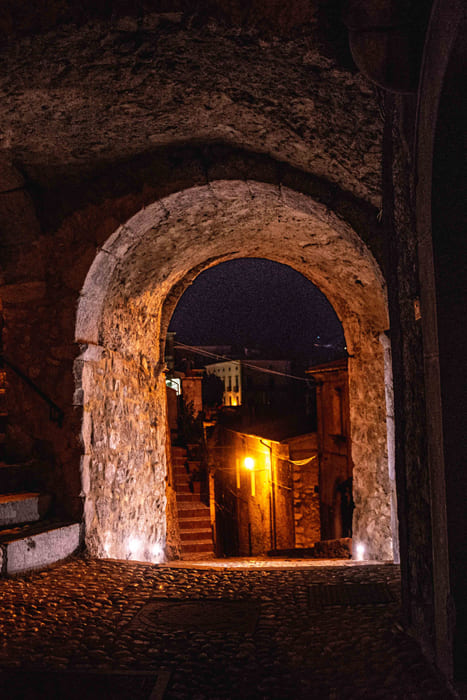
From the Tower go down towards the picturesque alley bearing the same name, called “glie Ammarieglie” in the local dialect, back to Rione Valle through the Arch of San Donato (East gate), whose typical late Gothic pointed structure is the result of the influence of the Cantelmo family: on it you can still see today the stone holes where the pins were inserted to open and close the gate.
Walking along via Pedicata reach the Cathedral, built in honour of Santa Maria and San Marcello the Pope, whose origins date back to the 14th century but which was expanded and refurbished following the Baroque style in the 18th century. The choir and the organ, made by Cesare Catarinozzi, are remarkable. Under the high altar, a glass coffin treasures the body of Saint Constance, a martyr from the Roman age whose remains were transported here in the 18th century from the Catacombs of San Callisto in Rome. Opposite the Cathedral you can see the 18th-century Palazzo Quadrari, bearing Roman epigraphs along the wall of its staircase of honour.
Going down from via Annunziata and via Belfiore, before going back to the square, you can have a quick visit to Largo Lago, a small square with a plane tree at the centre and low houses around, where in winter the elderly sit on the benches to tell stories from the past: the place is named after an artificial lake that had been built there in the past to collect rainwater used to operate the mill located in the area known as Mole.
End your tour going back to the square through the passage called “Spuort’ dell'Alluvione”, where there is a hand-painted ceramic tile mosaic dedicated to the flood (alluvione in Italian) that hit the town on September 28th, 1798.
After the tour around the ancient part of the town, a visit is worth to be paid to the countless paths mixing history and nature that San Donato offers: in addition to the many hiking tours in the National Park, you can enjoy long walks to Forca d'Acero valley, on the sites of the Bourbon limonite mines dating back the kingdom Ferdinand II, and the mountain bike route to discover old fountains and springs in the area. Routes and points of historical-cultural interest can be easily found thanks to the system of information panels that, together with the beauty of the town, have earned San Donato Val di Comino the Orange Flag of the Italian Touring Club. San Donato Val di Comino la Bandiera Arancione del Touring Club Italiano.
"Living Villages" chain of the Ciociaria-Valle di Comino DMO:

Il programma del FestiVal di Comino sarà organizzato in sette grandi aree tematiche, per offrire un racconto completo e variegato della Valle, valorizzandone identità, storia e potenzialità.
Clicca sulle aree tematiche per scoprire gli eventi in programma.
Il calendario è in continuo aggiornamento con nuove attività: torna spesso per scoprire tutte le novità.

Via Umberto I, 1 - 03030 Pescosolido (FR)
Con il contributo della


DMO Ciociaria Valle di Comino 2024 C.F: 91033330605 | Tutti i diritti riservati. | by idealmente.net
| Cookie | Durata | Descrizione |
|---|---|---|
| cookielawinfo-checkbox-analytics | 11 months | This cookie is set by GDPR Cookie Consent plugin. The cookie is used to store the user consent for the cookies in the category "Analytics". |
| cookielawinfo-checkbox-functional | 11 months | The cookie is set by GDPR cookie consent to record the user consent for the cookies in the category "Functional". |
| cookielawinfo-checkbox-necessary | 11 months | This cookie is set by GDPR Cookie Consent plugin. The cookies is used to store the user consent for the cookies in the category "Necessary". |
| cookielawinfo-checkbox-others | 11 months | This cookie is set by GDPR Cookie Consent plugin. The cookie is used to store the user consent for the cookies in the category "Other. |
| cookielawinfo-checkbox-performance | 11 months | This cookie is set by GDPR Cookie Consent plugin. The cookie is used to store the user consent for the cookies in the category "Performance". |
| viewed_cookie_policy | 11 months | The cookie is set by the GDPR Cookie Consent plugin and is used to store whether or not user has consented to the use of cookies. It does not store any personal data. |

