
Almost razed to the ground on January 13th, 1915, by a terrible earthquake known as the Earthquake of Marsica, it is in the ruins of the hills known as Colle San Giovanni, the high rock marking the old town centre, that you can “read” the traces of the past: leaving from Nenz’ Cort, the magnificent terrace overlooking the town and bringing your gaze towards Campoli Appennino and the Abruzzo region, you can wander through the narrow alleys looking for how the town was. On your way, stop by the Church of San Rocco, with its simple yet impressive stone facade, or by the Church of the Saints John the Baptist and John the Evangelist: after climbing the long staircase in front of the church, step in to admire the Baptism of Christ, an artwork by Gaspare Capricci from the 18th century, and the Madonna del Rosario, whose credit is given to the art school of Marco Mazzaroppi.
Almost razed to the ground on January 13th, 1915, by a terrible earthquake known as the Earthquake of Marsica, it is in the ruins of the hills known as Colle San Giovanni, the high rock marking the old town centre, that you can “read” the traces of the past: leaving from Nenz’ Cort, the magnificent terrace overlooking the town and bringing your gaze towards Campoli Appennino and the Abruzzo region, you can wander through the narrow alleys looking for how the town was. On your way, stop by the Church of San Rocco, with its simple yet impressive stone facade, or by the Church of the Saints John the Baptist and John the Evangelist: after climbing the long staircase in front of the church, step in to admire the Baptism of Christ, an artwork by Gaspare Capricci from the 18th century, and the Madonna del Rosario, whose credit is given to the art school of Marco Mazzaroppi.
On your way out of the town, going back onto Corso Umberto I, a visit is worth to Palazzo Cianfarani Isola, a neo-Renaissance building from the early 20th century, which was the headquarters of the local German command during the Second World War and whose interiors are decorated with Art Deco frescoes.
From the square named after the date of the earthquake, Piazza 13 gennaio 1915, another path can be covered, the one of countryside chapels: an old track going from the small hamlet of Forcella to Pescosolido and leading you to discover the “Cone”, the term describing the small chapels that can be found in Italy scattered here and there. Among them it is worth mentioning the picturesque chapel dedicated to Madonna del Vallone, with its 16th century fresco, the Church of San Pantaleone and the Chapel of Madonna della Neve.
If you like to take another leap into history, have a walk along the “Grande Cammino dei Briganti”, the bandit trail along which Pescosolido represents the 5th and 6th stop, going from Balsorano to Pescosolido and from Pescosolido to Alvito respectively. The town was affected by banditry in the early years after the Unification of Italy, with the bandits Luigi Alonzi called Chiavone and Gaetano Mammone.
For nature lovers, from the local place named Prati di Pescosolido, enjoy the trails towards the hill Colle Carovenzi, with its peculiar fountain dating back to the 19th century, and the tableland of Vallone Lacerno, on the borders with Campoli Appennino, the most beautiful wild area surrounded by Marsica area and Lazio mountains, from which you can reach the refuge of Campo di Grano downhill, a place for pasture and a point of reference for local shepherds.
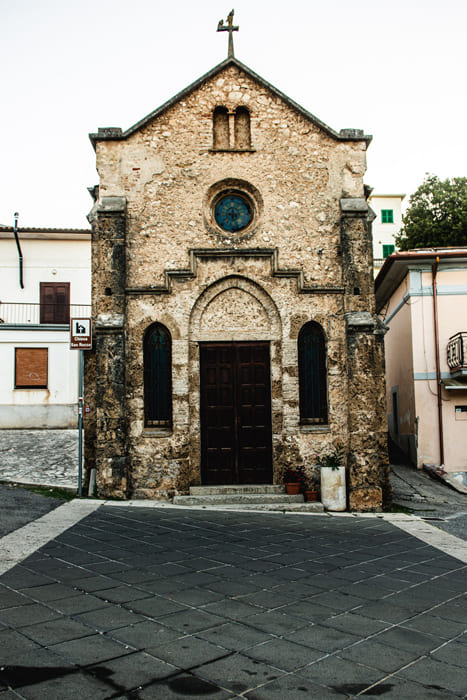
Almost razed to the ground on January 13th, 1915, by a terrible earthquake known as the Earthquake of Marsica, it is in the ruins of the hills known as Colle San Giovanni, the high rock marking the old town centre, that you can “read” the traces of the past: leaving from Nenz’ Cort, the magnificent terrace overlooking the town and bringing your gaze towards Campoli Appennino and the Abruzzo region, you can wander through the narrow alleys looking for how the town was. On your way, stop by the Church of San Rocco, with its simple yet impressive stone facade, or by the Church of the Saints John the Baptist and John the Evangelist: after climbing the long staircase in front of the church, step in to admire the Baptism of Christ, an artwork by Gaspare Capricci from the 18th century, and the Madonna del Rosario, whose credit is given to the art school of Marco Mazzaroppi.
Almost razed to the ground on January 13th, 1915, by a terrible earthquake known as the Earthquake of Marsica, it is in the ruins of the hills known as Colle San Giovanni, the high rock marking the old town centre, that you can “read” the traces of the past: leaving from Nenz’ Cort, the magnificent terrace overlooking the town and bringing your gaze towards Campoli Appennino and the Abruzzo region, you can wander through the narrow alleys looking for how the town was. On your way, stop by the Church of San Rocco, with its simple yet impressive stone facade, or by the Church of the Saints John the Baptist and John the Evangelist: after climbing the long staircase in front of the church, step in to admire the Baptism of Christ, an artwork by Gaspare Capricci from the 18th century, and the Madonna del Rosario, whose credit is given to the art school of Marco Mazzaroppi.
On your way out of the town, going back onto Corso Umberto I, a visit is worth to Palazzo Cianfarani Isola, a neo-Renaissance building from the early 20th century, which was the headquarters of the local German command during the Second World War and whose interiors are decorated with Art Deco frescoes.
From the square named after the date of the earthquake, Piazza 13 gennaio 1915, another path can be covered, the one of countryside chapels: an old track going from the small hamlet of Forcella to Pescosolido and leading you to discover the “Cone”, the term describing the small chapels that can be found in Italy scattered here and there. Among them it is worth mentioning the picturesque chapel dedicated to Madonna del Vallone, with its 16th century fresco, the Church of San Pantaleone and the Chapel of Madonna della Neve.
If you like to take another leap into history, have a walk along the “Grande Cammino dei Briganti”, the bandit trail along which Pescosolido represents the 5th and 6th stop, going from Balsorano to Pescosolido and from Pescosolido to Alvito respectively. The town was affected by banditry in the early years after the Unification of Italy, with the bandits Luigi Alonzi called Chiavone and Gaetano Mammone.
For nature lovers, from the local place named Prati di Pescosolido, enjoy the trails towards the hill Colle Carovenzi, with its peculiar fountain dating back to the 19th century, and the tableland of Vallone Lacerno, on the borders with Campoli Appennino, the most beautiful wild area surrounded by Marsica area and Lazio mountains, from which you can reach the refuge of Campo di Grano downhill, a place for pasture and a point of reference for local shepherds.
"Living Villages" chain of the Ciociaria-Valle di Comino DMO:

Il programma del FestiVal di Comino sarà organizzato in sette grandi aree tematiche, per offrire un racconto completo e variegato della Valle, valorizzandone identità, storia e potenzialità.
Clicca sulle aree tematiche per scoprire gli eventi in programma.
Il calendario è in continuo aggiornamento con nuove attività: torna spesso per scoprire tutte le novità.

Via Umberto I, 1 - 03030 Pescosolido (FR)
Con il contributo della


DMO Ciociaria Valle di Comino 2024 C.F: 91033330605 | Tutti i diritti riservati. | by idealmente.net
| Cookie | Durata | Descrizione |
|---|---|---|
| cookielawinfo-checkbox-analytics | 11 months | This cookie is set by GDPR Cookie Consent plugin. The cookie is used to store the user consent for the cookies in the category "Analytics". |
| cookielawinfo-checkbox-functional | 11 months | The cookie is set by GDPR cookie consent to record the user consent for the cookies in the category "Functional". |
| cookielawinfo-checkbox-necessary | 11 months | This cookie is set by GDPR Cookie Consent plugin. The cookies is used to store the user consent for the cookies in the category "Necessary". |
| cookielawinfo-checkbox-others | 11 months | This cookie is set by GDPR Cookie Consent plugin. The cookie is used to store the user consent for the cookies in the category "Other. |
| cookielawinfo-checkbox-performance | 11 months | This cookie is set by GDPR Cookie Consent plugin. The cookie is used to store the user consent for the cookies in the category "Performance". |
| viewed_cookie_policy | 11 months | The cookie is set by the GDPR Cookie Consent plugin and is used to store whether or not user has consented to the use of cookies. It does not store any personal data. |

